
Buried Italy: Campania Felix
Get ready for an adventure beneath the surface of Italy. This is a journey for the curious and the bold — for those who want to climb down into the buried, submerged, and forgotten worlds of ancient Campania, and then come back up to eat and drink like the ancients who built them. Over seven unforgettable days we explore the volcanic landscape of the Phlegraean Fields and the Bay of Naples, where Greek colonists, Roman emperors, and the wrath of Vesuvius each left an entire world entombed beneath the next. We will walk Roman tunnels and Greek cisterns hidden beneath the streets of Naples, sail in glass-bottomed boats over a sunken city of emperors at Baia, stand on the shore of the crater lake the Romans swore was the doorway to the underworld, and step into cities frozen in time by the ash of 79 AD.
And we will taste it all. We will raise glasses of Lacryma Christi on the very slopes of Vesuvius — the wine grown from the same volcanic soil that Pliny the Elder wrote about and that the Romans prized above almost any other. We will eat true Neapolitan pizza in the city that invented it, pull fresh mozzarella di bufala by hand on a working farm, and toast our final evening with an Aglianico, the noble red the ancient Greeks are believed to have carried to these shores nearly three thousand years ago. Throughout, the thread that ties our week together is the tension between what is buried and what is still gloriously alive — a journey that ends among Greek temples more complete than any still standing in Greece itself. And as always, expect a few surprises along the way.
Itinerario de la Expedición
Welcome to Campania and the volcanic heart of the Bay of Naples! We will meet you at the airport for a private transfer to your accommodation on the seafront in Bacoli — the very stretch of coast where, in myth, Hercules himself rested with the great herd of oxen he had stolen from the giant Geryon. You will be sleeping at the edge of legend.
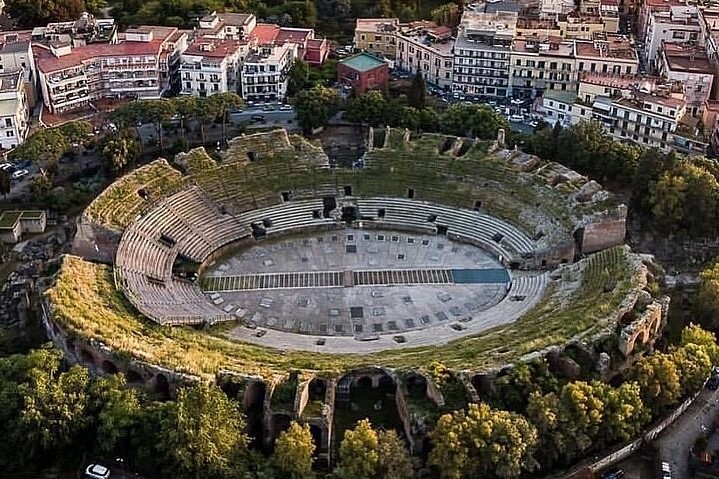
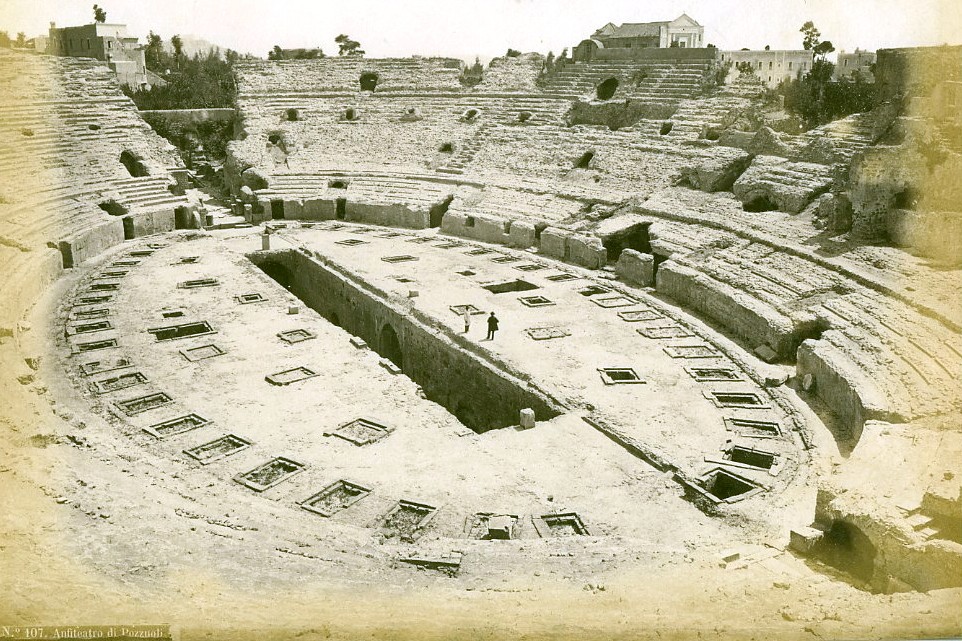
Today we begin where the earth is most alive. We visit the Flavian Amphitheater of Pozzuoli, Italy's third-largest Roman arena, descending into its extraordinary underground hypogeum where gladiators and wild animals once waited in darkness beneath the arena floor. We continue to the Temple of Serapis — not a temple at all, but a Roman covered market whose columns still bear the bore-marks of sea creatures, proof that the entire site has sunk beneath the sea and risen again over the centuries through the slow breathing of the super volcano, a phenomenon known as bradyseism. There will be free time for lunch in Pozzuoli. In the afternoon we explore Rione Terra, the excavated Roman acropolis of ancient Puteoli hidden beneath the tuff rock — its streets, granaries, and a bakery with millstones still in place. The Solfatara crater, though currently closed to visitors, will be seen and discussed along the way as a vivid reminder that the Campi Flegrei is a living, breathing volcano beneath our very feet.
Evening: Enjoy a delicious welcome supper of traditional Neapolitan fare with local wine at a genuine trattoria in Bacoli, where we raise a glass to the adventure ahead.
Overnight in Bacoli
Today we discover how the fire beneath this coast shaped Greek mythology, which in turn shaped the very foundation of the Roman world. We begin at the Castello di Baia and its archaeological museum, home to a true rarity: the Villa of Julius Caesar, only recently brought back to light and freshly reopened to visitors. To walk these grounds is to stand on the promontory where Caesar himself looked out over the bay, and where, by tradition, Cleopatra received the news of his assassination on the Ides of March. Few travelers will have set foot here before us. We then take to the water for a glass-bottomed boat or snorkeling tour out over the submerged city of Baia itself — the dazzling pleasure resort of Roman emperors, now lying five to eight meters beneath the waves, its streets, mosaics, and marble statues swallowed by the same bradyseism we witnessed at the Macellum the day before.
In the afternoon we stand on the shore of Lago d'Averno, the volcanic crater lake the Romans believed was the literal entrance to the underworld — its sulfurous vapors were said to kill birds in mid-flight, giving it the name Avernus, 'without birds.' It was through here that Virgil sent his hero Aeneas down into the realm of the dead. We continue to Cumae, the oldest Greek colony in the western Mediterranean, near the Villa Vergiliana. Here, conditions permitting, we visit the amphitheater of Cumae — one of the earliest stone arenas in the entire Roman world, in the very region where many historians believe gladiatorial combat in an arena was first born. We end at the haunting Cave of the Sibyl, the great vaulted tunnel where Aeneas consulted the prophetess before his descent. Mythology, geology, and history collide in a single unforgettable afternoon — and we will taste wine from these same volcanic slopes, the kind of wine the ancient Romans themselves once raised to their gods.
Overnight in Bacoli
Today we head into Naples, a city some 2,500 years old, to enter the buried world that lies directly beneath it. We begin at the Crypta Neapolitana, a 700-metre Roman road tunnel carved straight through the Posillipo hill and still walkable after two thousand years. At its entrance lies the tomb of Virgil himself — the poet who placed the underworld at Lago d'Averno, visited only the day before, now resting forever between the tunnel and the sea. The thread of Virgil that has followed us all week comes full circle here.
We then sit down to a true Neapolitan pizza for lunch — and here is the surprise that opens up four thousand years of history: pizza was invented right here in Naples, but the flatbread beneath it was not. Long before Naples existed, the workers who raised the pyramids of ancient Egypt were paid in grain flatbreads, and from that ancient root the story runs all the way to the table in front of us. The pizza we eat is the living, delicious end of a four-thousand-year tradition. In the afternoon we go underground beneath the church of San Lorenzo Maggiore to explore the buried city of the Greeks, the Romans, and the early Christians — a hidden warren of streets, shops, and walls carved from and built upon the golden tuff stone on which all of Naples stands. It is an archive of two and a half thousand years of human life, lying silent beneath a city that has simply kept building over its own past, again and again.
Overnight in Bacoli
This morning we step into a world reserved for very few. At Oplontis we explore the Villa of Poppaea — the sumptuous seaside retreat believed to have belonged to Poppaea Sabina, the second wife of the Emperor Nero. The forgotten third city destroyed in 79 AD, Oplontis is arguably the most beautifully preserved Roman villa in all of Italy, its frescoes still vivid, its gardens still traceable, and yet it remains gloriously free of crowds — a private, almost secret glimpse into the luxury of the imperial elite. In the afternoon we move to Herculaneum, which, unlike its more famous neighbor Pompeii, was sealed beneath a torrent of pyroclastic mud that carbonized rather than destroyed. Here wooden furniture, food, and even fabric survive after two thousand years — and most movingly of all, in the boat houses by the ancient shoreline, we come face to face with the remains of those who did not escape: the men, women, and children who ran to the sea hoping for rescue that never came. It is haunting, intimate, and unforgettable.
In the early evening, we make the short transfer south around the great cone of Vesuvius to Sorrento — the only change of hotel in the entire week. We check into our charming boutique hotel in the heart of the historic center, just steps from the lively Piazza Tasso, where the evening is yours to wander and to choose from the many wonderful restaurants within easy walking distance.
Overnight in Sorrento
Today we walk into Pompeii, the most famous archaeological site in the world — but we arrive with four full days of context behind us, so that the Forum, the Villa of the Mysteries, and the plaster casts of the dead in the Garden of the Fugitives strike with a weight most visitors never feel. And there is more to see now than ever before: we explore the remarkable new excavations of the Regio IX district, only recently opened to the public, where archaeologists have uncovered breathtaking frescoes, a fresco-lined banquet hall, a bakery, and even ancient graffiti — discoveries so fresh that they are still rewriting what we know about daily life in the doomed city. We see not merely ruins, but a living city understood at last within the volcanic landscape that both made and unmade it.
In the afternoon we climb the slopes of Vesuvius itself for a wine tasting and lunch at a family-run cantina, sampling Lacryma Christi del Vesuvio — the 'Tears of Christ,' grown in the rich volcanic soil born of the very eruption that buried the city we walked through that morning. This is wine the Romans treasured and Pliny the Elder praised, and to drink it here, in the shadow of the volcano, is the thesis of our entire week made gloriously edible: from destruction, something extraordinary still grows.
Overnight in Sorrento
Today we travel north to Santa Maria Capua Vetere, home to the second-largest amphitheater in the Roman world after the Colosseum — the very arena where Spartacus trained and where the greatest gladiatorial school of the empire once operated. Its underground hypogeum is intact and almost entirely free of visitors, and we walk the corridors beneath the arena where the fighters waited.
In the afternoon we visit the Mithraeum of Santa Maria Capua Vetere, one of the most complete underground Roman temples to the god Mithras anywhere in existence — a secret mystery religion practiced in darkness beneath the city, its fresco of Mithras slaying the bull among the finest preserved in the world. Almost no one comes here. This is Buried Italy at its most hidden and most atmospheric.
Overnight in Sorrento
On our final full day, we travel south into the wild beauty of the Cilento to Elea, the ancient Greek city of Velia, founded around 540 BC by Greek refugees who had fled the Persian conquest of their homeland. This unassuming city gave the world something extraordinary: the Eleatic school of philosophy, founded here by Parmenides and his pupil Zeno. It was Parmenides who first argued that reality is one, unchanging, and eternal — that the change we see is an illusion — laying the very foundations of Western metaphysics and logic, while Zeno's famous paradoxes of motion still puzzle students of philosophy and mathematics today. To stand here is to stand at the birthplace of a way of thinking that shaped all of Western thought. And here the Porta Rosa — the only surviving fourth-century BC Greek arch in the world — still stands in the Mediterranean scrub above the sea, with almost no other visitors to share it.
At midday we visit a working buffalo farm on the Cilento plain near Capaccio, the true heartland of DOP mozzarella di bufala campana, where we watch the cheese pulled by hand and taste it within hours of being made — the living food tradition that has outlasted every buried city around it. In the afternoon we reach Paestum and its three magnificent Doric temples, more complete than almost anything still standing in Greece itself, and its museum, home to the celebrated Tomb of the Diver: a fresco from 480 BC of a young man diving into the underworld, sealed in the earth for nearly 2,500 years. After a week spent between what is buried and what is still alive, there could be no more perfect final image.
Evening: We gather for a farewell supper at a beloved traditional restaurant in Sorrento, raising a final glass — and it must be an Aglianico, the noble red the ancient Greeks are believed to have first carried to these very shores nearly three thousand years ago, its name a whisper of the word 'Hellenic' itself. We came, we descended, we discovered the buried worlds of Campania together — and we ate and drank our way gloriously through the living one.
Overnight in Sorrento
Good morning, and after one final breakfast we transfer you to the airport or station for your onward journey. We hope you were amazed by this special program, created for those who have a passion for the buried history of Italy and who dare to go beneath the surface to discover the real Campania.
Departure dates 2027
Fri 2 Apr - Sat 10 Apr
Fri 30 Apr - Sat 8 May
Fri 4 Jun - Sat 12 Jun
Fri 10 Sep - Sat 18 Sep
Fri 1 Oct - Sat 9 Oct
- 4 nights at a charming boutique hotel on the seafront in Bacoli (Calea Hotel or similar) with breakfast
- 3 nights at a charming boutique hotel in the historic center of Sorrento (Hotel Antiche Mura or similar) with breakfast
- Discovery tours of the Campi Flegrei (Pozzuoli, Baia, Lago d'Averno, Cumae), Naples, Oplontis and Herculaneum, Pompeii and Vesuvius, Santa Maria Capua Vetere, and the Cilento (Elea/Velia and Paestum)
- Glass-bottom boat or snorkeling tour over the submerged Roman city of Baia
- Transportation in a private minibus during all touring
- Private transfers from Naples airport to the hotel on arrival, and from Sorrento to Naples airport on departure
- Entries include: day ticket to the Campi Flegrei archaeological park, the Flavian Amphitheater, Rione Terra, the Castello di Baia and the Villa of Julius Caesar, the boat tour over submerged Baia, the underground of San Lorenzo Maggiore, Oplontis, Herculaneum, Pompeii (including the new Regio IX excavations), the amphitheater and Mithraeum of Santa Maria Capua Vetere, and the archaeological parks of Velia and Paestum
- A welcome supper on Day 1 and a farewell supper on Day 7
- A wine tasting and lunch at a Lacryma Christi vineyard on the slopes of Vesuvius
- A mozzarella di bufala farm visit and tasting in the Cilento
- Special commentary throughout by an Italian Cultural Expert trained by historian, author, and Italian Cultural Expert Joseph Walker, on the buried history and living culture of Campania
- Documents of a personal nature such as a passport with at least 6 months validity
- Airfare (should arrive in Naples on [date] and plan to leave from Naples on [date] unless extending your stay) — we can assist upon request
- Tips or gratuities
- Meals not listed as included
- Travel insurance (highly recommended and we can assist if requested)
- Anything specifically not mentioned under “Included”