The Forgotten Kingdom of Southern Italy
Come and immerse yourself in the forgotten kingdom — the great, lost south of Italy that most travelers never see. This is the Mezzogiorno, the land the guidebooks skip on the way to Rome and Florence, and yet it holds some of the most extraordinary buried history anywhere on earth. Over eight unforgettable days we journey from Naples all the way down to the very toe of the Italian boot, traveling backward through time as we go — from the lost Bourbon kingdom that Italian unification erased, through the Norman conquerors who first forged the Kingdom of Sicily, past abandoned ghost towns and cave cities carved from the rock, and down at last into Magna Graecia, the world the ancient Greeks built here long before Rome was ever an empire.
Few realize that this corner of Italy was once the beating heart of the Mediterranean — that Greek philosophers, Norman kings, Lombard dukes, and Spanish viceroys all left their mark here before history moved on and left their kingdoms buried and forgotten. We will descend into the Bourbon tunnels beneath Naples, stand inside the haunting cave dwellings of Matera, walk the silent streets of a medieval ghost town, and meet two Greek bronze warriors who spent two thousand years on the floor of the sea. And everywhere, the great theme of our journey: the tension between what is buried and what is still gloriously alive.
And we will taste that living history at every turn. We will eat our way through the bold, sun-soaked cooking of the south — fiery 'nduja, fresh Lucanian bread, buffalo mozzarella and silky burrata cheese, and seafood pulled from two seas. We will raise glasses of Aglianico del Vulture, the noble red grown on a dormant Basilicata volcano, and of Cirò, the ancient Calabrian wine the Greeks brought to these shores almost three thousand years ago and once poured for the victors of the original Olympic Games. We will sip the golden, herb-scented Strega liqueur in the very town of Benevento where it has been made for generations, taste the celebrated Amarelli licorice — the 'black gold of Calabria,' crafted by the same family since 1731 — and close our journey with a special farewell dinner. There will be wine tastings and long convivial lunches all along the way — and, as always, a few surprises.
Expedition Itinerary
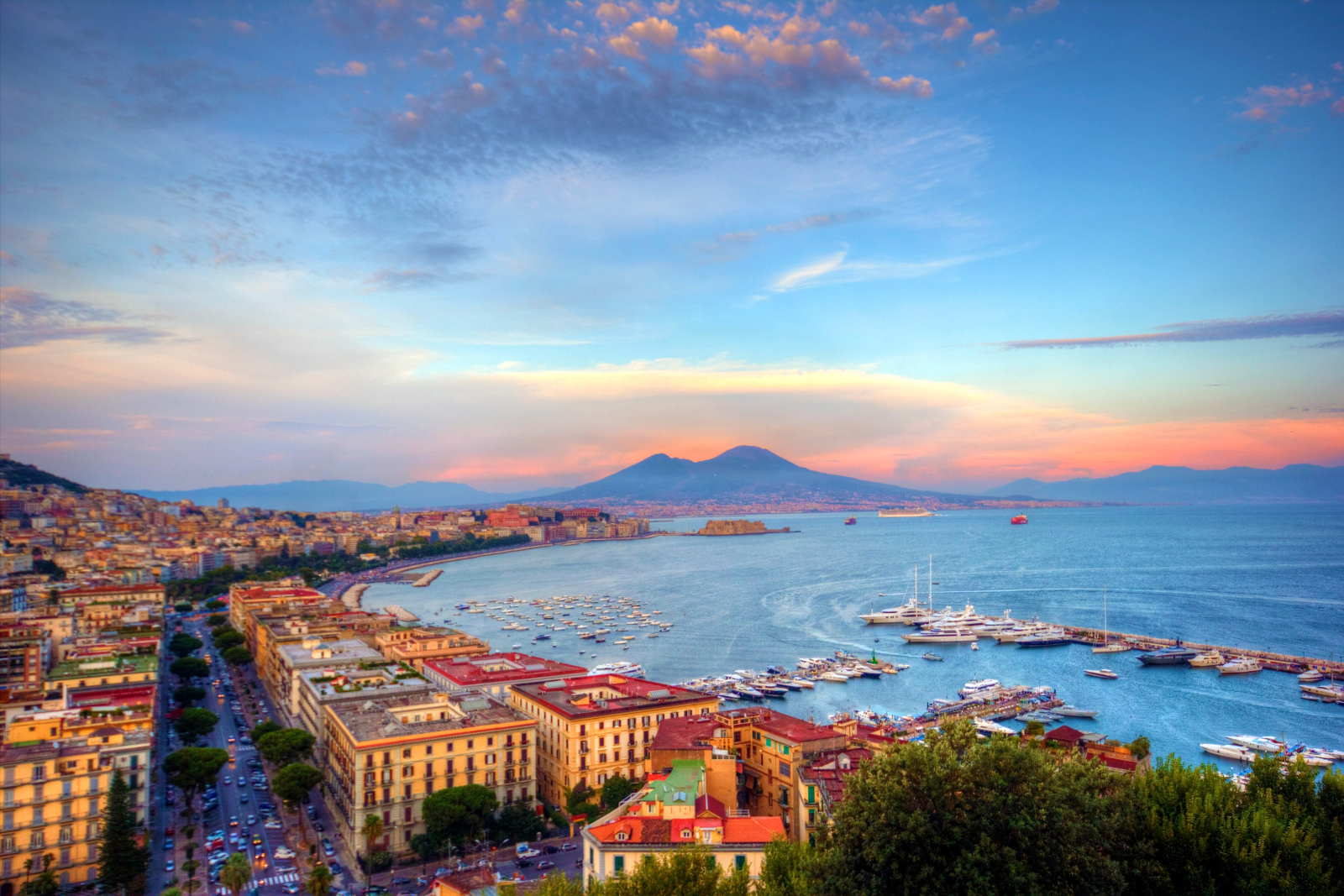
Welcome to Naples and to the south of Italy! We will meet you at the airport for a private transfer to your accommodation in the heart of this magnificent, chaotic, and utterly alive city. For more than five hundred years Naples was no mere regional town but a royal capital — the seat of the Kingdom of the Two Sicilies, the largest and most populous state in all of Italy, a kingdom that was swept away and all but erased from memory when Italy was unified in 1861. This is where our story of the forgotten kingdom begins.
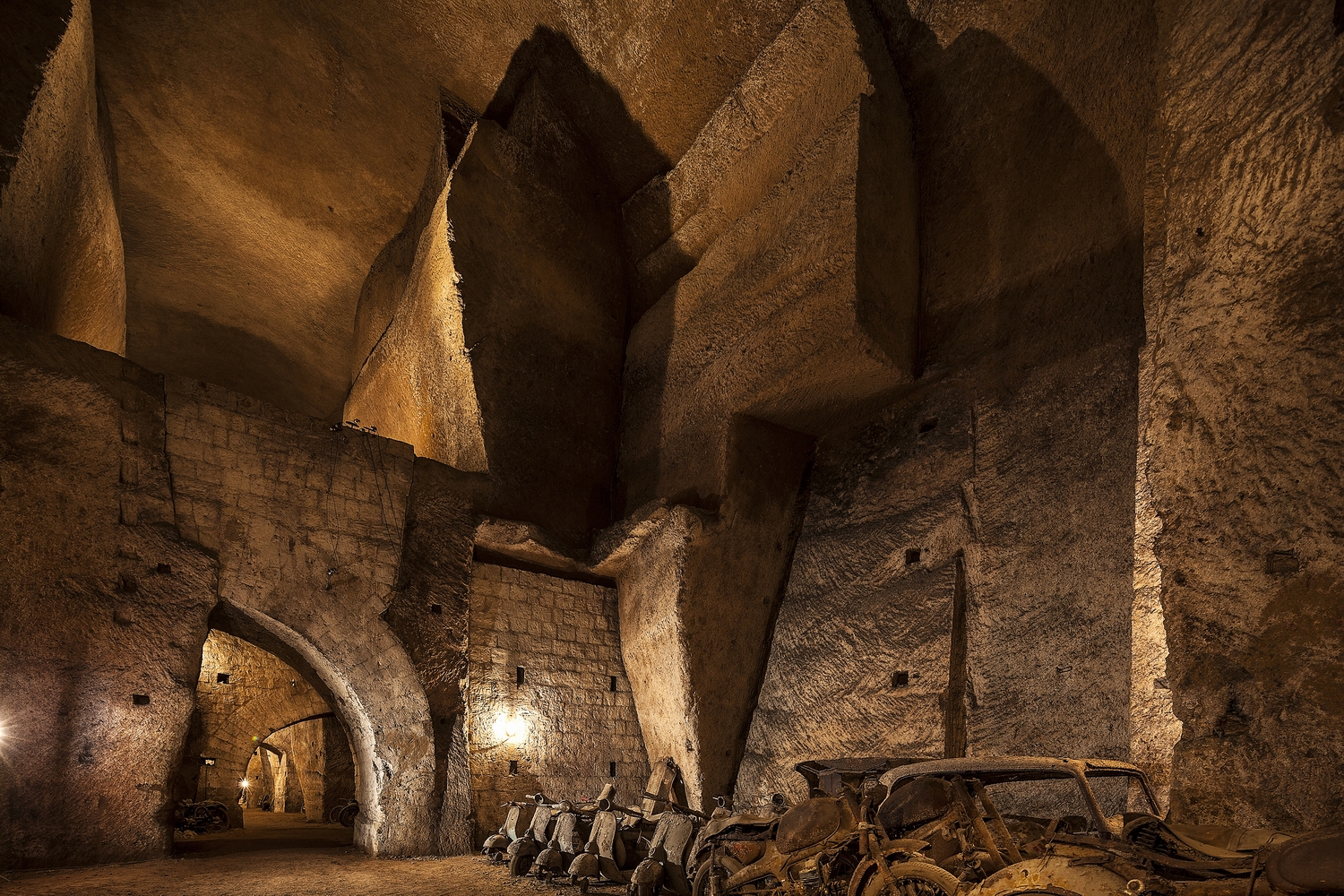
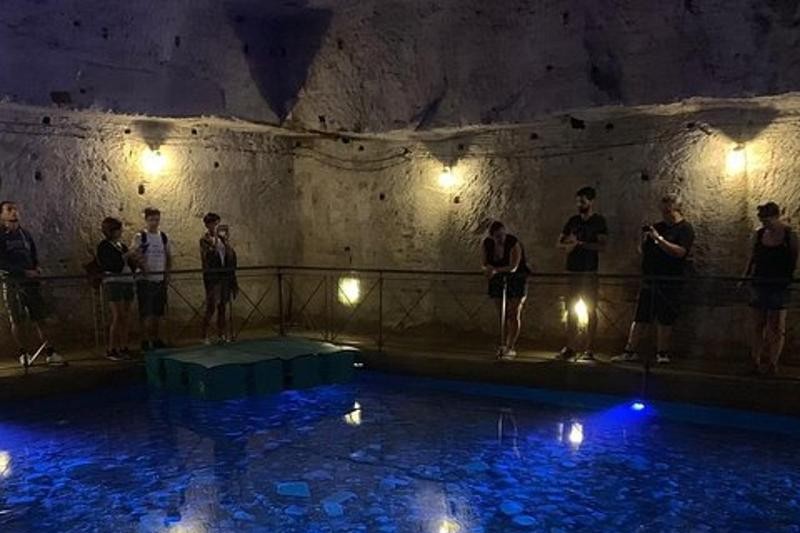
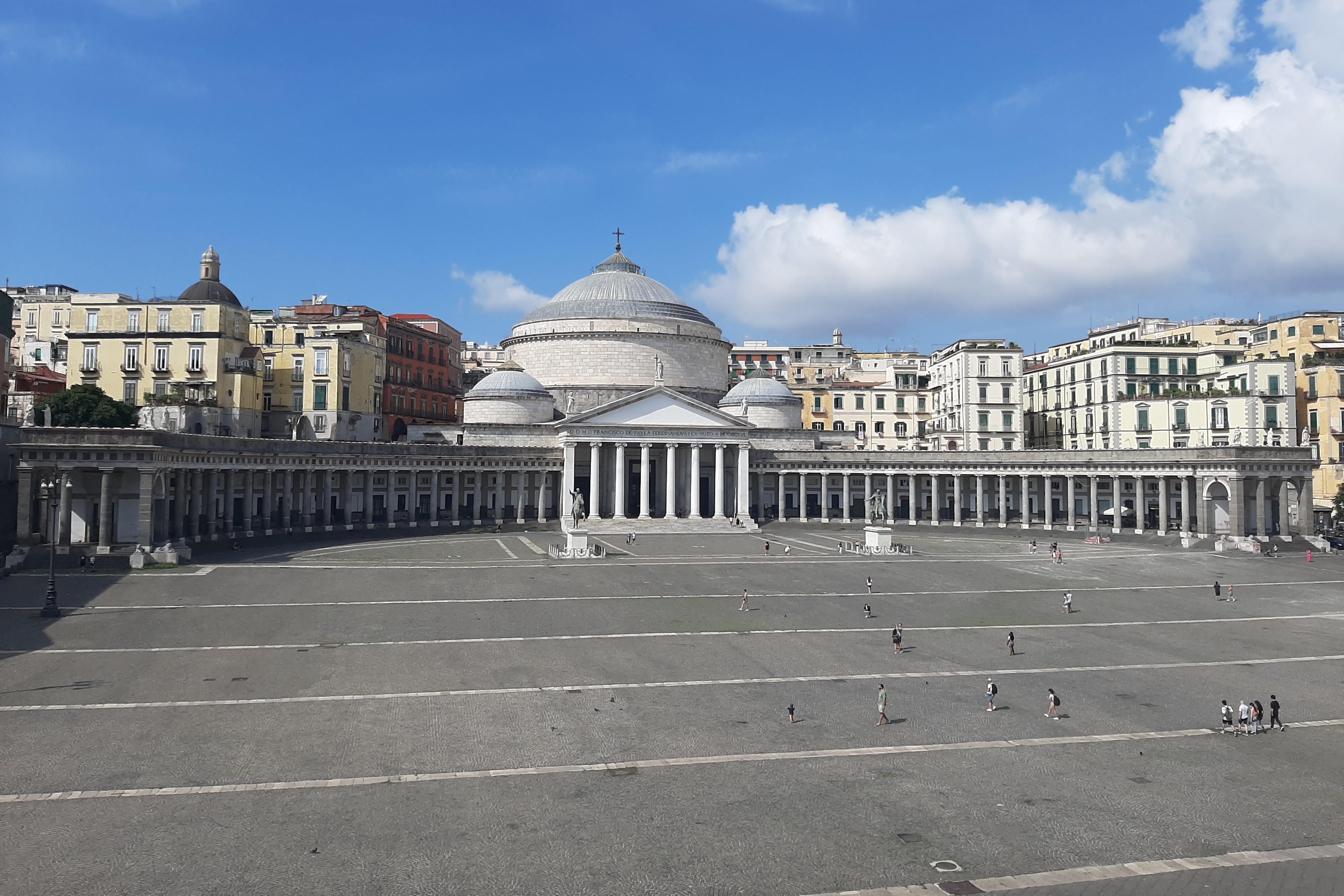
Today we explore the capital of the lost kingdom. We descend into the Galleria Borbonica — the Bourbon Tunnel, an underground passage begun by King Ferdinand II as a secret royal escape route beneath the city, later used as an air-raid shelter and a hidden world of cisterns and aqueducts carved from the golden tuff stone on which Naples is built. Above ground, we take in the grand royal face of the kingdom at Piazza del Plebiscito, the vast colonnaded square framed by the Royal Palace and the great domed church of San Francesco di Paola, with its commanding equestrian monuments to the Bourbon kings. Nearby stands the Teatro di San Carlo, the oldest continuously active opera house in the world, founded in 1737 — decades before La Scala in Milan — and the glittering musical heart of a royal capital that, before Italian unification, rivaled Paris and Vienna. We will also explore the historic center, a UNESCO World Heritage labyrinth of churches, palaces, and streets that have layered Greek, Roman, medieval, and Bourbon history one atop the other for 2,500 years.
Evening: We gather for a delicious welcome supper of traditional Neapolitan fare with local wine, raising a glass to the adventure ahead.
Overnight in Naples
After breakfast we drive to the Reggia di Caserta, the staggering royal palace built by the Bourbon kings to rival Versailles itself — twelve hundred rooms, a soaring marble staircase, and gardens that stretch for nearly two miles to a great cascade. This was the glittering seat of the kingdom that unification erased, and to walk its halls is to feel the scale of a power the history books have largely forgotten.
In the afternoon we move inland to Benevento, one of the most quietly remarkable towns in all of Italy. Once the capital of a powerful Lombard duchy that ruled much of the south for five hundred years, Benevento today is almost entirely overlooked — and yet here stands the magnificent Arch of Trajan, one of the best-preserved ancient Roman arches in the world, and the church of Santa Sofia, a UNESCO World Heritage masterpiece of Lombard architecture. It was here, too, that the Beneventan chant flourished — an ancient, hauntingly beautiful form of sacred music that predates and rivals Gregorian chant, and which was very nearly lost to history entirely. And it was at Benevento, in 1156, that Pope Adrian IV formally recognized and ceded all of southern Italy to the Norman Kingdom of Sicily — the very kingdom whose rise and fall we follow on this journey. Before we leave, we will sample the town's most famous creation: Strega, the golden, saffron-hued herbal liqueur that has been distilled here since 1860, and which gives its name and its legend to the 'witches' of Benevento. A more perfect emblem of our theme — buried, forgotten, and yet still alive — could hardly be found.
In the evening we arrive in Canosa di Puglia, our base for the night and the gateway to Castel del Monte. Canosa is itself a town layered deep in the forgotten history of the south: it was to Canosa that the shattered remnants of the Roman army fled for refuge after Hannibal annihilated them at the nearby Battle of Cannae in 216 BC, one of the bloodiest defeats Rome ever suffered. Centuries later the Normans made the town their own — and here, beside the cathedral, stands the mausoleum of Bohemund of Hauteville, Prince of Antioch and son of Robert Guiscard, the only freestanding Norman royal tomb in all of Italy. Tomorrow we will stand at the tomb of the father at Venosa; tonight we rest beside the tomb of the son.
Overnight in Canosa di Puglia
This morning we visit one of the great enigmas of medieval Europe: Castel del Monte, the mysterious octagonal crown of stone raised by the Emperor Frederick II, the Hohenstaufen heir to the Norman Kingdom of Sicily and one of the most extraordinary rulers in all of history. Perfectly octagonal, mathematically precise, and built for no clear military purpose, this UNESCO World Heritage castle has puzzled scholars for eight centuries — some have even believed it was designed, in part, to house the Holy Grail itself. Standing alone on its hilltop, it is the very image of a forgotten kingdom's lost ambition and mystery.
We continue to Venosa, where the story of the lost kingdom reaches back to its very founding. Here, in the unfinished abbey known as the Incompiuta, lie the tombs of the first Norman conquerors of the south — the Hauteville brothers, including the mighty Robert Guiscard, the adventurers who carved a kingdom out of Byzantine, Lombard, and Arab lands and founded the Kingdom of Sicily itself. From this small, unassuming town, Norman power once radiated out across the whole Mediterranean world. Venosa was also a great city of the ancient Via Appia, the queen of Roman roads, and the birthplace of Horace — one of the greatest poets of Rome, whose verses still echo more than two thousand years later. Here we will trace the path of that legendary road and the poet who walked it, before descending into Basilicata to Matera for the night.
Overnight in Matera
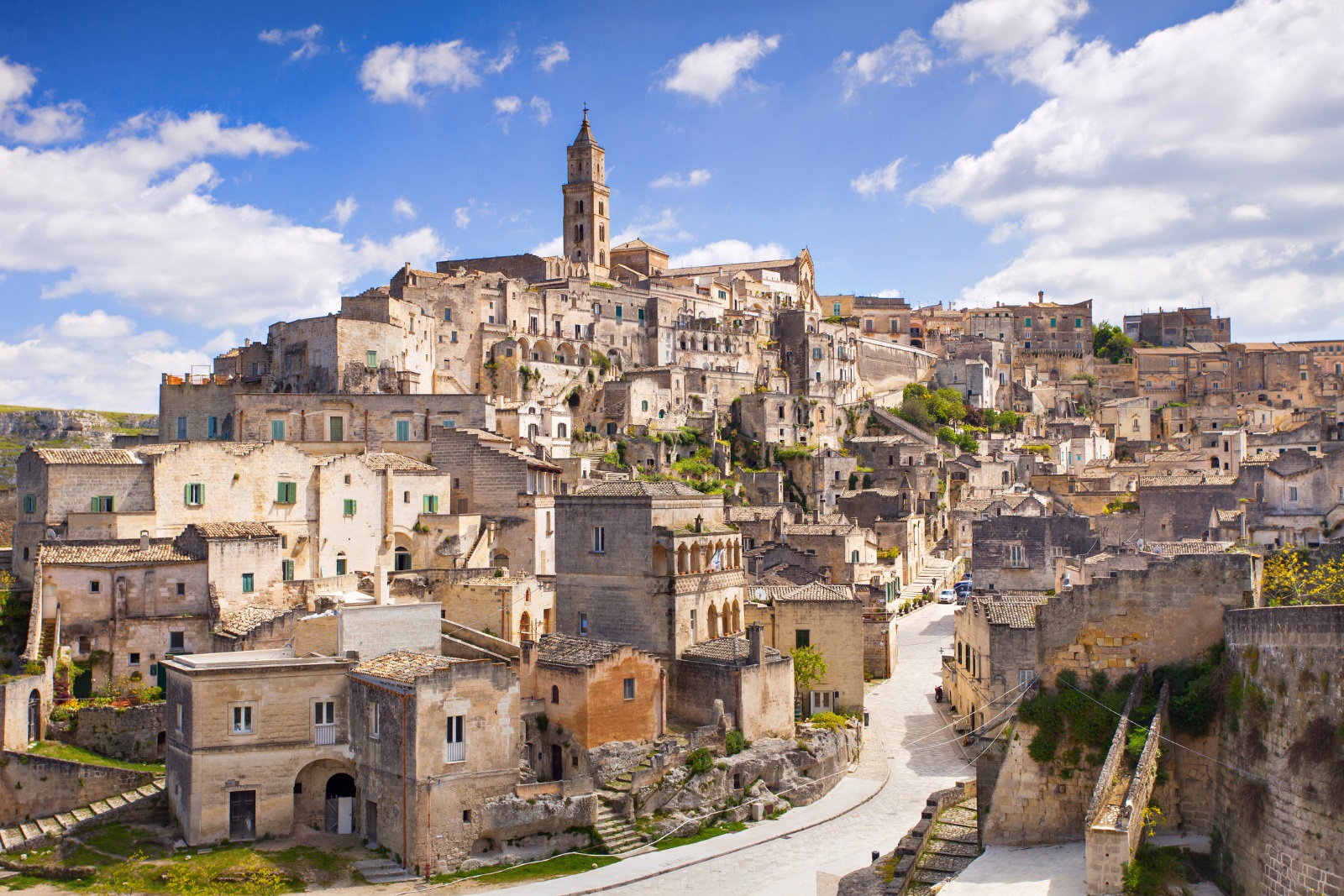
Today belongs to Matera, and it may be the most unforgettable day of the entire journey. The Sassi of Matera — the ancient cave dwellings carved into the soft tufa rock of a deep ravine — form one of the oldest continuously inhabited human settlements on the face of the earth, lived in without interruption for some nine thousand years. And yet within living memory this extraordinary place was abandoned in shame: in the 1950s the cave-dwellers, living in poverty among their animals, were forcibly relocated, and Matera was branded 'the shame of Italy' and left to die. Then, against all odds, it came back to life — restored, reborn, and today a UNESCO World Heritage Site and one of the most beautiful places in the country. Buried and still alive, in the most literal sense imaginable.
We will explore the labyrinth of the Sassi on foot, descending into ancient cave homes and the remarkable rock-hewn churches — the chiese rupestri — whose walls still glow with Byzantine frescoes painted by monks more than a thousand years ago. On a special guided visit we enter the Crypt of the Original Sin, a buried 8th-century cave church lost for centuries and rediscovered only in 1963, its astonishing frescoes by the anonymous master known as 'the Painter of the Flowers' so beautiful it is called the Sistine Chapel of rock churches. Reached along the ancient Appian Way outside the city and open only to small escorted groups by advance reservation, it is one of the most exclusive and moving sights in all of southern Italy. There will be time, too, to simply absorb this astonishing place, and to enjoy the warm cooking of Basilicata: the famous crusty bread of Matera, hearty peasant dishes, and the robust local wine.
Overnight in Matera
This morning we visit one of the most haunting and exclusive sights in all of Italy: Craco, a medieval town clinging to a hilltop crag, utterly abandoned. Wracked by landslides and finally evacuated in the late twentieth century, Craco today stands completely empty — a perfectly preserved ghost town of silent streets, roofless houses, and a lone Norman tower against the sky. So evocative is its desolation that filmmakers have used it as a backdrop for the ancient world. The town may be entered only on a privileged escorted visit, hard hats and guide included, and very few travelers ever set foot inside its walls. Few places on earth embody the idea of a buried, forgotten kingdom so powerfully — and we will have it almost entirely to ourselves.
Before we return to the coast, we pause for a leisurely included lunch at La Mangiatoia in nearby Bernalda, a family-run osteria in the same family's hands since 1965 and celebrated for the authentic, rustic cooking of Basilicata — cured meats and cheeses, handmade pasta, and grilled meats, paired with the region's local wines. It is exactly the sort of unhurried, deeply local meal that makes this corner of Italy so rewarding to visit slowly.
In the afternoon we cross into Magna Graecia — the world of the ancient Greeks — at Metaponto, on the Ionian coast. Here stand the elegant columns of the Tavole Palatine, the remains of a Doric temple to the goddess Hera, beside a fine archaeological museum. It was to Metaponto that the great philosopher and mathematician Pythagoras came in his final years, and here, by tradition, that he died. We remember Pythagoras today for his theorem, but his influence on Western thought runs far deeper: he was among the first to argue that the universe is governed by number and harmony, that reality can be understood through mathematics, and that the soul is immortal — ideas that shaped Plato, echoed through the whole of Western philosophy and science, and still underpin how we understand the cosmos. To stand among these columns where he taught and died is to step into the deepest layer of the forgotten kingdom — the Greek south that came centuries before Rome. In the late afternoon we leave the Ionian behind us and cross the toe of Italy to its western shore, arriving as the light turns to gold over the Tyrrhenian Sea.
Set on a cliff above the sea, its old town rising sheer from the rock and the little church of Santa Maria dell'Isola seeming almost to float above the water, Tropea is one of the most beautiful towns in all of Italy — and, for the next two nights, our base on what the Calabrians rightly call the Costa degli Dei, the Coast of the Gods. The evening is yours to wander its lanes, take in the view from the belvedere, and settle in before two days spent exploring the coast and hills around it.
Overnight in Tropea
This morning we climb into the hills above Tropea to Zungri, where an entire village lies carved directly into the soft sandstone of the cliffs — the Grotte degli Sbariati, a settlement of rock-cut homes, cisterns, and storerooms believed to date to the Byzantine Middle Ages, when monks or refugees fleeing the East are thought to have taken shelter here. Little known even to most Italians, it has been called a miniature Matera, and to walk among its carved stairways and doorways is to find, quite unexpectedly, another buried world in a region that keeps yielding them. Afterward we pause nearby for a wine tasting at a small family cantina in these Calabrian hills, a reminder that the old vineyard traditions of the ancient south run on quietly, far from the famous names.
In the afternoon we descend to the sea at Pizzo, a fishing town stacked in tiers above the water and crowned by the Castello Murat. It was here, in October 1815, that Joachim Murat — Napoleon's brother-in-law and, until that same year, King of Naples — met his end. Having lost his throne with Napoleon's fall, Murat staged a desperate attempt to reclaim the kingdom by landing at Pizzo with a handful of men; he was captured within hours, tried within days, and shot in the castle courtyard, reportedly asking his own firing squad to spare his face and aim for his heart. It is one of the most dramatic final chapters in the long story of the kingdom we have followed all week. Afterward, we do as every visitor to Pizzo must: we taste tartufo, the celebrated chocolate gelato said to have been invented in this very piazza, sitting in the shadow of the castle where a king once fell.
The evening is free to enjoy Tropea at leisure — dinner on your own in one of its many fine restaurants, or simply the sunset from the belvedere above the sea.
Overnight in Tropea
We leave Tropea a little later than usual this morning, leaving time for those who wish to take one more walk through its clifftop lanes or down to the belvedere before we depart. We then travel south along the Costa Viola — the Violet Coast, named for the color its mountains take on at dusk — to Scilla, a fishing village gathered beneath a great rock crowned by the Castello Ruffo. Fortified since the fifth century BC and seized in 1060 by Robert Guiscard himself — the same Norman conqueror whose tomb we visited at Venosa — the castle's ramparts look straight across the Strait of Messina to Sicily. It was this narrow, treacherous water that gave the ancient world its myth of Scylla and Charybdis, the monster and the whirlpool between which Homer's Odysseus had to steer his ship; to stand on this rock is to stand inside one of the oldest stories in Western literature.
Scilla and its neighbors have fished these waters for swordfish since antiquity, using tall-masted boats built for spotting their prey from above, a tradition scarcely changed in two thousand years. Lunch here is on your own, and Scilla offers no shortage of wonderful options: a swordfish panino from Civico 5, credited with inventing the dish, or a full seafood lunch on the water at Ristorante Glauco or Il Pirata in the fishing village of Chianalea.
We then continue across the toe of Italy to Reggio Calabria, our final base, looking across the strait to Sicily. This evening we gather for a special farewell dinner, celebrating with the bold flavors and wines of Calabria the journey we have shared together through the forgotten kingdom.
Overnight in Reggio Calabria
On our final morning, here in Reggio Calabria at the very tip of the Italian boot, we come to the revelation that crowns our entire journey. In the National Archaeological Museum of Reggio Calabria stand the Riace Bronzes: two magnificent Greek warriors cast in bronze nearly 2,500 years ago, among the very finest Greek sculptures to survive anywhere in the world. Lost in a shipwreck and buried for two thousand years on the floor of the sea, they were pulled from the waters off the Calabrian coast in 1972, miraculously intact. To stand face to face with these two silent warriors — buried for millennia, and now astonishingly alive before us — is the perfect final image of all we have discovered: the forgotten kingdom of the south, buried and yet still gloriously alive.
Afterward we transfer you to Reggio Calabria airport for your onward journey home (flights typically connect through Rome or Milan). We hope you were amazed by this special program, created for those with a passion for the buried history of Italy and the courage to go off the beaten path to discover the real south.
Departure dates
Sat 8 May - Sat 15 May
Sat 9 Oct - Sat 16 Oct
- 7 nights of charming 3-star superior and 4-star hotels with breakfast
- 1 night in Naples ([hotel] or similar)
- 1 night in Canosa di Puglia ([hotel] or similar)
- 2 nights in Matera, including a stay in or near the historic Sassi ([hotel] or similar)
- 2 nights in Tropea ([hotel] or similar)
- 1 night in Reggio Calabria ([hotel] or similar)
- Discovery tours of Naples and the Bourbon underground, Caserta, Benevento, Castel del Monte, Venosa, Matera, Craco, Metaponto, Tropea, Zungri, Pizzo, Scilla, and Reggio Calabria
- Transportation in a private minibus throughout the program
- Private transfers from Naples airport on arrival and to Reggio Calabria airport on departure
- Entries include: the Galleria Borbonica, the Reggia di Caserta, Santa Sofia and the sites of Benevento, Castel del Monte, the abbey of Venosa, the Sassi and rock churches of Matera, the guided visit to the Crypt of the Original Sin, the escorted visit to Craco, the archaeological park of Metaponto, the rock-cut village of Zungri, the Castello Murat in Pizzo, the Castello Ruffo in Scilla, and the National Archaeological Museum of Reggio Calabria with the Riace Bronzes
- A welcome supper on Day 1 in Naples, an included regional lunch on Day 5 at La Mangiatoia in Bernalda, and a special farewell dinner on Day 7 in Reggio Calabria
- A wine tasting in the hills above Tropea; a tasting of Strega liqueur in Benevento; and a tasting of tartufo di Pizzo in the piazza where it was invented
- Special commentary throughout by an Italian Cultural Expert trained by historian, author, and Italian Cultural Expert Joseph Walker, on the buried history and living culture of southern Italy
- An extra night in Naples before the tour begins, should your flight schedule require an earlier arrival — we can assist upon request
- Documents of a personal nature such as a passport with at least 6 months validity
- Airfare (should arrive in Naples on [date] and plan to depart from Reggio Calabria on [date], typically connecting through Rome or Milan, unless extending your stay) — we can assist upon request
- Tips or gratuities
- Meals not listed as included
- Travel insurance (highly recommended and we can assist if requested)
- Anything specifically not mentioned under “Included”